.
.
.
Clean Green Golf Balls Details
Shark Tank Episode Details
The Shark Tank Pitch
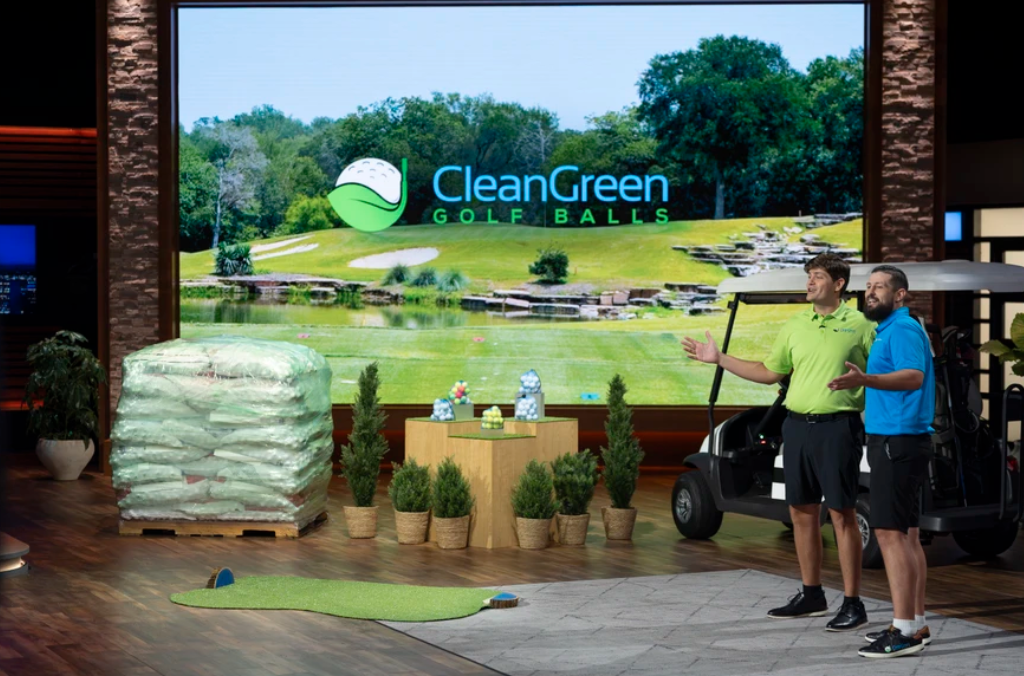
Rami and Sami Mubasher built Clean Green Golf Balls around inventory that other golfers had already paid for and lost. Divers, course workers and nearby homeowners supplied the recovered balls; the brothers' Bastrop, Texas operation cleaned them, sorted them by brand and condition, and sold them back into the game.
Their first test was unusually decisive: a batch of 20,000 used balls sold in a weekend in 2021. By their March 2026 Season 17 appearance, the brothers were seeking $350,000 for 5%.
A premium ball did not stop being a premium ball simply because somebody hit it into a pond, they argued. They described selling a dozen mint-condition Titleist Pro V1 balls for about $27, compared with clubhouse prices of $55 to $70 for new ones.
The financial history gave the Sharks plenty to consider. The founders reported $1 million in sales from June through December 2021, $3 million in 2022 and $6 million in 2024, with roughly $700,000 in profit on that last figure.
At filming, they projected $7.1 million for the current year. Their average landed cost was about 32 cents per ball, against an average selling price of $1.25.
Finding an online customer cost around $14, and the average order was about $50. They wanted help reaching more buyers through social media. Allison Ellsworth and Daymond John did not see themselves as the right partners, while Lori Greiner felt the brothers already had a strong business.
Kevin O'Leary offered $350,000 for 10% with a royalty that would continue at a reduced rate after he recovered his investment. Robert Herjavec offered the same cash for 17%, without a royalty.
Instead of picking one, the brothers asked them to team up. The combined offer was $350,000 for 15%, plus a $1 royalty with payments capped at $1.05 million.
Rami and Sami tried to bring the equity down to 12%, but the Sharks held at 15%. The brothers accepted the joint offer.

Join the Discussion
See what the r/sharktank community is saying about this pitch
Where Are They Now?
Clean Green Golf Balls continues to buy used balls as well as sell them, keeping both sides of its recycling operation open after Shark Tank. As of October 24, 2026, its supplier page lets people estimate the value of their collected balls and request a prepaid shipping label.
Incoming batches go to the company's Bastrop warehouse, where the balls are soaked, machine-scrubbed, dried and hand-sorted. The shop separates mint, near-mint and good-condition balls, with additional shag and range options.
Even the mint category can include a previous owner's pen marks or a corporate logo, a useful detail for customers expecting an unmarked ball. Shoppers can choose familiar brands including Titleist, Callaway, TaylorMade and Bridgestone, or order mixes in quantities from a dozen to 100.
Personalization adds a different side of the business, with uploaded photographs, pet images, faces and custom text alongside personalized tees. They had also been working on the unglamorous side of online growth before the television appearance.
In an August 2025 ShipStation customer interview, Sami said their previous shipping software had cost the operation about an hour and a half each morning through outages and other problems. The replacement system integrated their negotiated postal rates, and ShipStation reported eliminating that daily downtime.
The current company team page assigns product acquisition to Rami, marketing to Sami and equipment responsibilities to Mohamed, alongside staff handling management and customer service. Kevin O'Leary and Robert Herjavec's on-air agreement remains publicly unconfirmed as a completed investment.
The Southern Texas PGA lists Clean Green among its 2026 corporate partners, with Rami and Sami among the company's representatives.
Revenue
$7-8 million
Latest Coverage