
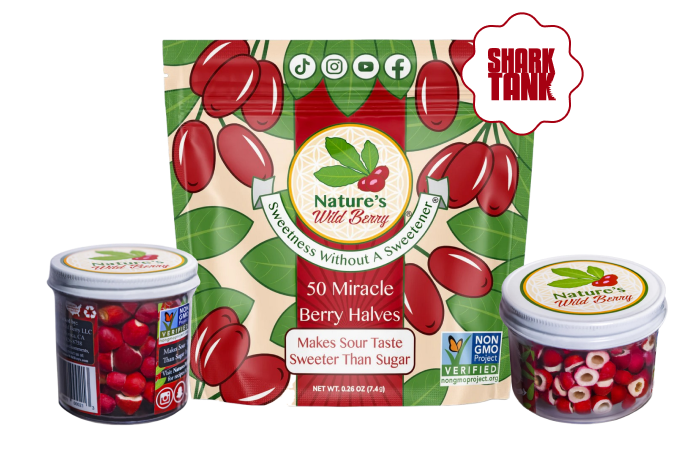
Two Shark Tank companies are sending very different signals in August 2026. Natures Wild Berry has entered a new business-to-business channel through US Foods Direct, making its freeze-dried miracle berries easier for eligible restaurants, hotels, caterers and other foodservice operators to order. Alchemize Fightwear, meanwhile, still has a live, polished website and an active founder profile, but its official apparel catalog currently contains no products.
One story is a measurable distribution step. The other requires more restraint: there is enough evidence to say Alchemize is not selling apparel normally through its main storefront, but not enough to declare that the company has closed. Together, the updates show why a working website, a distribution announcement and an operating business are related signals—not interchangeable conclusions.
| Company | Verified August 2026 signal | What it does not prove |
|---|---|---|
| Nature’s Wild Berry | Travel Jar listed for eligible customers on US Foods Direct | That every US Foods warehouse stocks it or that operators have adopted it at scale |
| Alchemize Fightwear | Official site remains live, but the main product collection is empty | That the company has permanently closed |
Nature’s Wild Berry Moves From Consumer Curiosity to Foodservice Ordering
Nature’s Wild Berry announced on August 21 that its plastic-free Travel Jar had been listed on US Foods Direct. Eligible US Foods customers can search approved product number 1170767 or request it through a representative. The listing is for a case containing four Travel Jars. Startup CPG subsequently published the announcement through its Newswire on August 25.
The wording matters. US Foods Direct is an ‘endless aisle’ dropship marketplace integrated into US Foods’ MOXē ordering platform. US Foods says Direct products ship to customers through FedEx and can have different lead times from conventional distributor inventory. Nature’s Wild Berry has therefore gained access to a major foodservice ordering system; the announcement does not say its jars are stocked in every US Foods distribution center or delivered on every regular restaurant truck.
That is still meaningful for an unusual product. A chef who encounters miracle berries at a trade show or online no longer has to establish an entirely separate purchasing relationship. If the operator is eligible, the jars can be ordered inside a system already used for other foodservice purchases. Reducing that administrative friction is often the first practical step between an interesting product demonstration and repeat commercial use.
Why Miracle Berries Could Fit a Foodservice Menu
The product’s effect is experiential. Miracle berries contain miraculin, a taste-modifying glycoprotein. Research on the human sweet receptor found that miraculin can remain bound to the receptor and become active under acidic conditions, changing the perception of a sour food toward sweetness. It changes what the diner perceives; it does not remove the food’s sugar, carbohydrates or acidity.
That creates menu possibilities beyond selling a packaged snack. Nature’s Wild Berry says early foodservice interest has included tasting menus, zero-proof beverage programs, hotel and catering receptions, and university dining programs encouraging students to try sour fruits and vegetables. Those are company-reported use cases rather than named customer contracts, but they illustrate why the foodservice channel may be more than a larger version of direct-to-consumer sales. The berry can become part of the experience itself.
The format appears designed for that environment. According to the company, the current Travel Jar is plastic-free, shelf stable at room temperature, contains no allergens and carries a best-by date of March 2035. A long shelf life matters for an ingredient that may be used for special events or tasting programs rather than consumed at the pace of an everyday kitchen staple. These storage and allergen statements come from Nature’s Wild Berry’s announcement, not an independent product test.
The Shark Tank Deal Behind the New Channel
Hank Watt and Juliano Bonanni appeared in Shark Tank Season 14, Episode 21, which aired May 5, 2023. They asked for $80,000 for 15% equity. The site’s dataset records a deal with Mark Cuban and Lori Greiner for $80,000 for 20%, plus a $3-per-unit royalty until the investment was recouped.
The company says it has spent ten years creating awareness for a product category that most buyers have never encountered. Shark Tank and reaction videos helped solve the consumer-education problem because viewers could watch someone taste a lemon after eating the berry. Foodservice introduces a different test: whether chefs and operators see enough repeatable value to put it into an actual program rather than treat it as a one-time novelty.
The next useful milestones are not simply more potential reach. They are named foodservice placements, reorders, a larger case format or evidence that one of the proposed use cases becomes repeatable across multiple operators. For now, the precise update is encouraging but narrower: Nature’s Wild Berry is orderable by eligible US Foods customers through Direct, opening a serious new route to market.
What Is Happening With Alchemize Fightwear?
Alchemize Fightwear’s current picture is less clear. The official Shopify site is online, carries the company’s branding and mission, and invites visitors to join a community it describes as more than 50,000 women. Its pages continue to describe fightwear engineered for female athletes and link to the company’s contact form. But as of August 27, the main ‘Products’ collection states: ‘Sorry, there are no products in this collection.’ The homepage also emphasizes the brand story and training community rather than merchandise that can be purchased.
An empty catalog is a significant operating signal, especially for a company presented on Shark Tank as a direct-to-consumer apparel business. It is not, by itself, a closure announcement. Products can disappear during a restock, restructuring, supplier change, platform rebuild or strategic shift. Alchemize has not posted a clear statement on the site saying that the company is out of business, and the branded domain remains functional.
The Strong Business That Entered the Tank
Maya Nazareth entered Season 17, Episode 4 seeking $250,000 for 5% of Alchemize. At pitch time, the company reported $1.8 million in lifetime sales, $500,000 in 2024 revenue and a projection of $875,000 for 2025. The site’s dataset records an on-air agreement in which Lori Greiner, Kendra Scott and Alexis Ohanian offered $300,000 for 15%.
The concept addressed a real gap: combat-sports apparel designed around women’s bodies instead of reduced versions of men’s gear. Alchemize built more than a product catalog around that idea. Its grappling camps, athlete collaborations and community identity gave customers a reason to identify with the brand even when they were not actively shopping. That history helps explain why the current lack of products has prompted concern from women who valued its fit and design.
What the Public Evidence Says—and What It Does Not
A recent discussion in the BJJWomen community includes several customers describing delayed orders, slow communication and refunds. Some commenters said their orders were eventually refunded or delivered; others described issues they considered unresolved. These are individual, unverified accounts. They should not be treated as a complete record of Alchemize’s fulfillment history or as proof of intent, but the repetition of similar experiences is relevant context when the official catalog is also empty.
There are also positive signs of continuity. The Alchemize site and contact page remain live. Its page for the May 1–3, 2026 East Coast Women’s Grappling Retreat remains accessible, showing that the community side of the business operated into 2026. Nazareth’s personal site lists continuing speaking and mentoring activity and describes the Shark Tank agreement as a closed three-Shark deal. That is a company-controlled description rather than independent confirmation of the final investment paperwork, but it is more current than the uncertainty reported immediately after the episode.
The fairest status is therefore operationally uncertain. Alchemize’s brand and founder remain publicly visible, but new apparel is not currently available through the main official collection and no clear public explanation appears on the storefront. We found no reliable announcement confirming a permanent shutdown. Calling it definitively closed would go beyond the evidence; calling commerce normal would ignore what shoppers can see.
What Would Clarify Alchemize’s Next Chapter
- A direct company update: A short statement explaining whether apparel is paused, being restocked or being restructured would resolve most of the uncertainty.
- Live inventory: New products with clear availability and fulfillment windows would demonstrate that the retail operation has resumed.
- Customer-service visibility: Current response times and a process for older orders would help rebuild confidence among existing customers.
- A new community event: Another announced camp or program would show whether Alchemize is continuing as both an apparel company and a community platform.
- Independent deal confirmation: Confirmation from one of the three investors would make the post-show financing picture clearer.
There is a plausible and hopeful path forward. Alchemize built recognizable products for an underserved group and a community that still speaks warmly about the fit of its gear even while asking what happened. A transparent update, reliable fulfillment and a focused relaunch could preserve much of that goodwill. Until then, readers should rely on current inventory and direct company communication rather than old product listings or assumptions based on the Shark Tank appearance.
Two Very Different Post-Shark Tank Tests
Nature’s Wild Berry has solved one piece of its next growth problem: access. Its challenge is turning a US Foods Direct listing into repeat orders and identifiable foodservice uses. Alchemize has the opposite kind of asset—a recognizable mission and a community that wants the product—but must clarify whether and how its commerce operation will continue.
Neither story should be exaggerated. A distributor marketplace listing is not the same as national menu adoption, and an empty online catalog is not the same as a confirmed business closure. The useful update is the space between those extremes: Nature’s Wild Berry has opened a credible new channel, while Alchemize Fightwear remains visible but needs a clearer operating signal.
Sources
- Nature’s Wild Berry Enters Foodservice Through US Foods Direct — Nature’s Wild Berry, August 21, 2026
- Nature’s Wild Berry Enters Foodservice Distribution Through US Foods Direct — Startup CPG Newswire, August 25, 2026
- US Foods Direct — US Foods, accessed August 27, 2026
- Nature’s Wild Berry Wholesale and US Foods Ordering Details — accessed August 27, 2026
- Human Sweet Taste Receptor Mediates Acid-Induced Sweetness of Miraculin — Proceedings of the National Academy of Sciences, 2011
- Alchemize Fightwear Official Website — accessed August 27, 2026
- Alchemize Fightwear Products Collection — accessed August 27, 2026
- Maya Nazareth Press and Speaking Profile — accessed August 27, 2026
- What Happened to Alchemize Fightwear? — Reddit r/BJJWomen, 2026 (individual reports are unverified)
- Alchemize Fightwear Shark Tank Update — Geeks Around Globe, August 2026
- Shark Tank Season 14, Episode 21 and Season 17, Episode 4 — ABC; pitch and deal facts cross-checked against the site’s Shark Tank dataset.
