
The newest Double Soul update is not simply another celebrity-investor headline. In June 2026, Poppi cofounder Allison Ellsworth made a strategic six-figure investment in the sock company and agreed to advise it. Then, in an August interview, Doublesoul cofounder and CEO Allison Strumeyer revealed the unusually large experiment that came first: she and husband Ben Rosenbaum ordered 10,000 pairs of unproven socks at a cost of about $100,000 to see whether the idea had a market.
Together, those developments make Doublesoul a useful case study in how a modern consumer brand can move from an expensive product test to venture funding, celebrity participation, national television and a new strategic backer. They also expose a reporting conflict around Pete Davidson's original investment that is worth correcting rather than quietly repeating.
The $100,000 Test Behind Doublesoul
Strumeyer's path to socks was deliberate. In an August 2026 as-told-to interview published by Business Insider and distributed by Yahoo, she said she sold artist-designed T-shirts while attending the University of Pennsylvania and entered pitch competitions with Rosenbaum. After college, she spent about two years at BlackRock, then four years at Mirror, the connected-fitness startup acquired by Lululemon. She described the first role as training in high standards and the second as practical experience inside a scaling startup.
The founders believed everyday socks occupied an overlooked middle ground: bulk basics lacked personality, while many novelty socks did not deliver the comfort and function people wanted every day. But belief was not proof. Their first meaningful test required a minimum production order of 10,000 pairs, costing approximately $100,000. They distributed pairs through their network and encouraged recipients to post about them. According to Strumeyer, the resulting organic sales gave them evidence that customers were interested before Doublesoul officially launched in 2022.
This was not a cheap survey or a landing-page test. It committed real money to inventory, creating the risk that thousands of unwanted pairs would remain. The useful part of the story is not that every founder should make a six-figure opening order; most should not. It is that Strumeyer and Rosenbaum defined a concrete test, looked for actual buying behavior and used the response to decide whether to keep building.
Why Allison Strumeyer Did Not Immediately Quit Her Job
Strumeyer also pushed back on a familiar startup narrative: quitting a secure job as quickly as possible. She said she stayed employed while the company was taking shape and left only after outside funding gave her more confidence. Doublesoul ultimately raised about $2 million before appearing on Shark Tank. Inc. identified earlier backers including BAM Ventures, Blank Street Coffee cofounder Vinay Menda and Lalo cofounder Gregory Davidson.
That sequence matters. The founders took product risk with the initial inventory, but Strumeyer did not simultaneously maximize her personal income risk. She used her salary and prior operating experience while gathering evidence, then moved full time after the business had financing. It is a more measured version of entrepreneurship than the dramatic leap often celebrated online.
How Pete Davidson Became Part of the Company
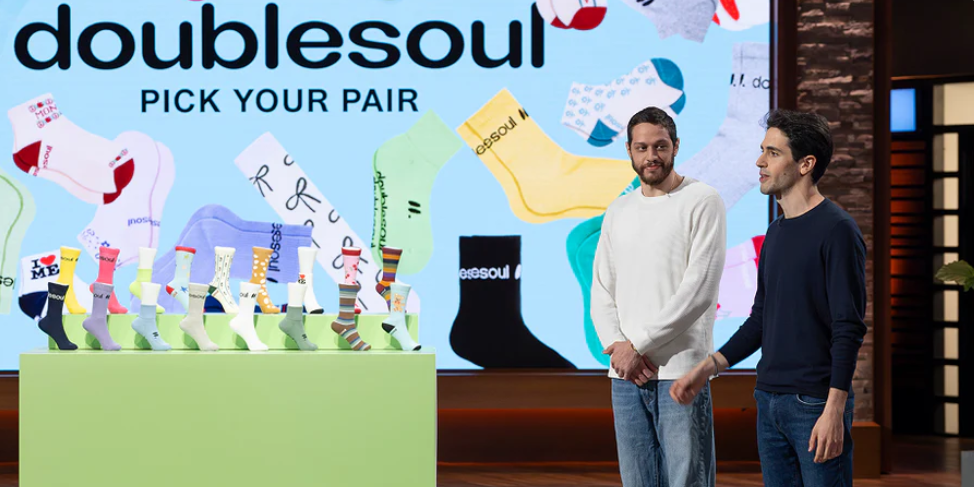
Strumeyer said Pete Davidson first received the socks, liked them and moved from customer to investor and close operating partner. Doublesoul's official site says Davidson joined as creative director in 2024. He has since designed a named collection, appeared in the Season 17 premiere and helped turn a basic apparel category into a celebrity-backed brand story.
The exact economics of Davidson's investment are less clear than some recent coverage suggests. WWD reported in June 2026 that Davidson invested $1 million for 10% in 2024. However, Inc.'s September 2025 account of the pitch says Davidson stated that he bought 10% at a company valuation of either $1 million or $2 million. A 10% purchase at those valuations would imply an investment of roughly $100,000 or $200,000—not $1 million. Because the accounts conflict, we are not presenting a definitive investment amount. What is consistently supported is that Davidson owns or owned 10%, invested before the Shark Tank appearance and serves as creative director.
Why Allison Strumeyer Missed the Shark Tank Pitch
The Season 17 pitch featured Rosenbaum and Davidson rather than both company founders. Strumeyer explained in her August interview that she was too far along in her pregnancy to travel when the episode taped. She remained part of the negotiation by phone: Rosenbaum and Davidson called her from the Tank before accepting Scott's offer. By the time the episode aired on September 24, 2025, the couple's son was three weeks old.
That context changes the television framing. Strumeyer was not a peripheral founder added after the show; she was the cofounder and CEO who could not safely make the trip, and the on-air team consulted her before agreeing to give up equity. Her absence was logistical, not organizational.
The Doublesoul Shark Tank Numbers
| Metric | Reported during the pitch |
|---|---|
| Original ask | $500,000 for 4% equity |
| Implied ask valuation | $12.5 million |
| 2022 sales | $360,000 |
| 2023 sales | $1.7 million |
| 2024 sales | $2.3 million |
| 2025 projection | $7.5 million—not a confirmed final result |
| Average retail price / production cost | Approximately $11 / $1.20 per pair |
| Reported gross margin | 89% |
| Accepted on-air offer | $500,000 for 10% from Kendra Scott |
| Implied deal valuation | $5 million |
The distinction between recorded sales and projections is important. The $7.5 million figure was a forecast presented during the pitch, not a verified year-end total. The company also disclosed a $380,000 loss for 2024, according to Inc., showing why strong gross margins do not automatically translate into bottom-line profit when a growing brand is spending on people, inventory and customer acquisition.
Scott's offer lowered the implied valuation from the founders' $12.5 million ask to $5 million. The team accepted after considering other proposals, including a more complicated Kevin O'Leary and Rashaun Williams structure involving equity and per-pair payments. Scott also discussed using her retail experience and store footprint to help the company expand. The parties publicly celebrate the relationship, and WWD now describes Scott as an investor, but the exact post-filming legal terms have not been published. The safest description remains the documented on-air agreement.
Allison Ellsworth's New Six-Figure Investment
The newest capital comes from Allison Ellsworth, cofounder of Mother Beverage, the Shark Tank company now known as Poppi. WWD reported on June 16, 2026, that Ellsworth made a strategic six-figure investment and joined Doublesoul as an adviser. Her remit includes brand vision, marketing, retail strategy, creator partnerships and consumer growth. The exact dollar amount, equity received and resulting company valuation were not disclosed.
The relationship predates both Shark Tank appearances. Ellsworth first met Strumeyer and Rosenbaum at a Poppi event in 2021 and informally mentored them during the company's early development. The new investment turns that multi-year relationship into a formal strategic partnership. WWD reported that the money is intended for product innovation, brand building, creator and community marketing, and expansion across direct-to-consumer, wholesale and strategic retail channels.
Ellsworth brings unusually relevant experience. She and husband Stephen built Poppi from a farmers-market beverage into a national brand after appearing on Shark Tank as Mother Beverage. PepsiCo completed its acquisition of Poppi in May 2025 for $1.95 billion, including anticipated tax benefits, with a stated net purchase price of $1.65 billion plus a performance-based earnout. That does not mean Doublesoul will follow the same financial path. It explains why the sock company values her advice on turning an ordinary repeat-purchase category into a culturally recognizable consumer brand.
There is another unusual connection: Ellsworth herself served as a guest Shark during Season 17. WWD specified that her Doublesoul investment was independent of that television role. She was not one of the Sharks present for the Doublesoul pitch; the panel for that episode included Scott and guest Shark Rashaun Williams.
What Doublesoul Is Building Now
Doublesoul continues selling directly through its website and presents itself around three ideas: comfort, self-expression and more sustainable materials. Its official product information lists blends that vary by silhouette and include organic cotton and Global Recycle Standard-certified recycled nylon, along with features such as cushioning, breathability, arch support and seamless toes. The company also uses non-gendered S-to-XL sizing while providing equivalent shoe-size guidance.
The catalog shows how creator partnerships became a repeatable merchandising system rather than a one-time celebrity endorsement. Current and archived collections feature Davidson and numerous artists, musicians, designers and online creators. The official site also maintains a Kendra Scott favorites collection tied directly to the Shark Tank appearance.
What to Watch After the New Investment
- Retail expansion: Ellsworth's advisory role explicitly includes retail strategy, and Scott emphasized physical retail during the pitch. New named retail partners would be a meaningful next milestone.
- Verified 2025 results: The $7.5 million figure was a projection. A confirmed result would show whether the company delivered the acceleration described in the Tank.
- Profitability: High product margins and a 2024 net loss can coexist. Future reporting should distinguish gross margin, sales and actual profit.
- Product breadth: The site now includes baby, toddler and grip-sock categories in addition to its core silhouettes, offering a way to grow without leaving the broader sock market.
- Investment clarity: Formal confirmation of the final Kendra Scott terms—or a correction to conflicting reports about Davidson's check—would make the capitalization story clearer.
The strongest conclusion is not that a $100,000 inventory gamble automatically leads to Shark Tank or famous investors. Doublesoul's progression was more disciplined: test a tangible product, keep employment during the uncertain stage, raise outside capital, use culturally relevant partners and recruit advisers whose experience matches the next growth problem. The new Ellsworth investment adds another credible operator to that strategy, but the next proof points will come from retail execution, confirmed sales and a path from impressive gross margins to sustainable profit.
Sources
- I Was Too Pregnant to Pitch My Business on Shark Tank—Business Insider via Yahoo, August 13, 2026
- A Former BlackRock Employee Ordered 10,000 Pairs of Socks—The Times of India, August 18, 2026
- Doublesoul Gets Six-figure Investment From Allison Ellsworth—WWD, June 16, 2026
- This Sock Brand Shocked Shark Tank Judges—and Landed a $500,000 Investment—Inc., September 25, 2025
- About Doublesoul—official company website, accessed August 20, 2026
- PepsiCo Completes Acquisition of Poppi—PepsiCo, May 19, 2025
- Shark Tank Season 17, Episode 1—ABC, aired September 24, 2025; pitch and deal terms cross-checked against the site's Shark Tank dataset.