Shark Tank updates do not always arrive in tidy themes. Sometimes three unrelated companies simply hit milestones worth checking on at the same time. This week's group includes an after-school program opening location number three, a dessert franchise reaching roughly 50 outposts, and a sustainable cleaning brand aiming for more than $500 million in lifetime sales.
The businesses have almost nothing in common operationally. One depends on trusted local staff, one grows through franchisees, and one sells patented consumer products through subscriptions and national retailers. That contrast is exactly what makes this roundtable useful: it shows three very different meanings of the word “scale.”
| Company | New milestone | Important qualifier |
|---|---|---|
| R1SE | Three Michigan locations | Nationwide expansion is the plan, not the current footprint |
| Crispy Cones | Roughly 50 U.S. outposts reported | The figure is an approximate location count from Axios |
| Blueland | $500M+ lifetime-sales target | The company expects to cross it by the end of 2026; it has not reported reaching it yet |
R1SE Opens Its Third Location—and Tests a Repeatable Model
R1SE is the newest Shark Tank company in this group. Trevor and Heather Szafranski appeared in Season 17, Episode 15 on March 25, 2026, asking for $300,000 for 10% of their education-and-recreation business. Barbara Corcoran invested $300,000 for 15%.
R1SE combines structured academic support with the recreational spaces children actually want to use. Students can receive help with homework, tests, projects, and leadership skills before moving into areas for gaming, sports, movies, art, and STEM activities. The pitch was not merely about tutoring; it was about making after-school support useful to children and workable for employed parents.
At pitch time, R1SE operated in Freeland and Midland, Michigan. The founders said the two centers were serving about 120 students per day, and Trevor told the Sharks that each facility generated roughly $600,000 in annual gross revenue with net margins around 21%. Those were pitch-time figures, not updated 2026 results, but they help explain why Corcoran saw a model that might be replicated.
Frankenmuth Turns the Expansion Plan Into Something Physical
On August 12, Mid-Michigan NOW reported that R1SE had expanded to a third facility in Frankenmuth. The location had progressed from “under construction” at the time of the March coverage to hosting families at an open house. Trevor said the business had originally been intended as a single-location idea; it now has three.
The important phrase in the new report is not simply “third location.” R1SE expects Frankenmuth to function as a model for future facilities. A founder can operate one successful center through personal relationships and constant attention. A third center begins testing whether the layout, staffing, programming, and parent experience can be reproduced without weakening the original concept.
This is not yet a nationwide operation. All three locations are in Michigan. Szafranski says R1SE intends to expand throughout the state and eventually across the United States, but that is a stated plan rather than an accomplished footprint. The most accurate update is that R1SE has moved from local proof of concept to early regional replication.
Crispy Cones Reaches Roughly 50 Outposts
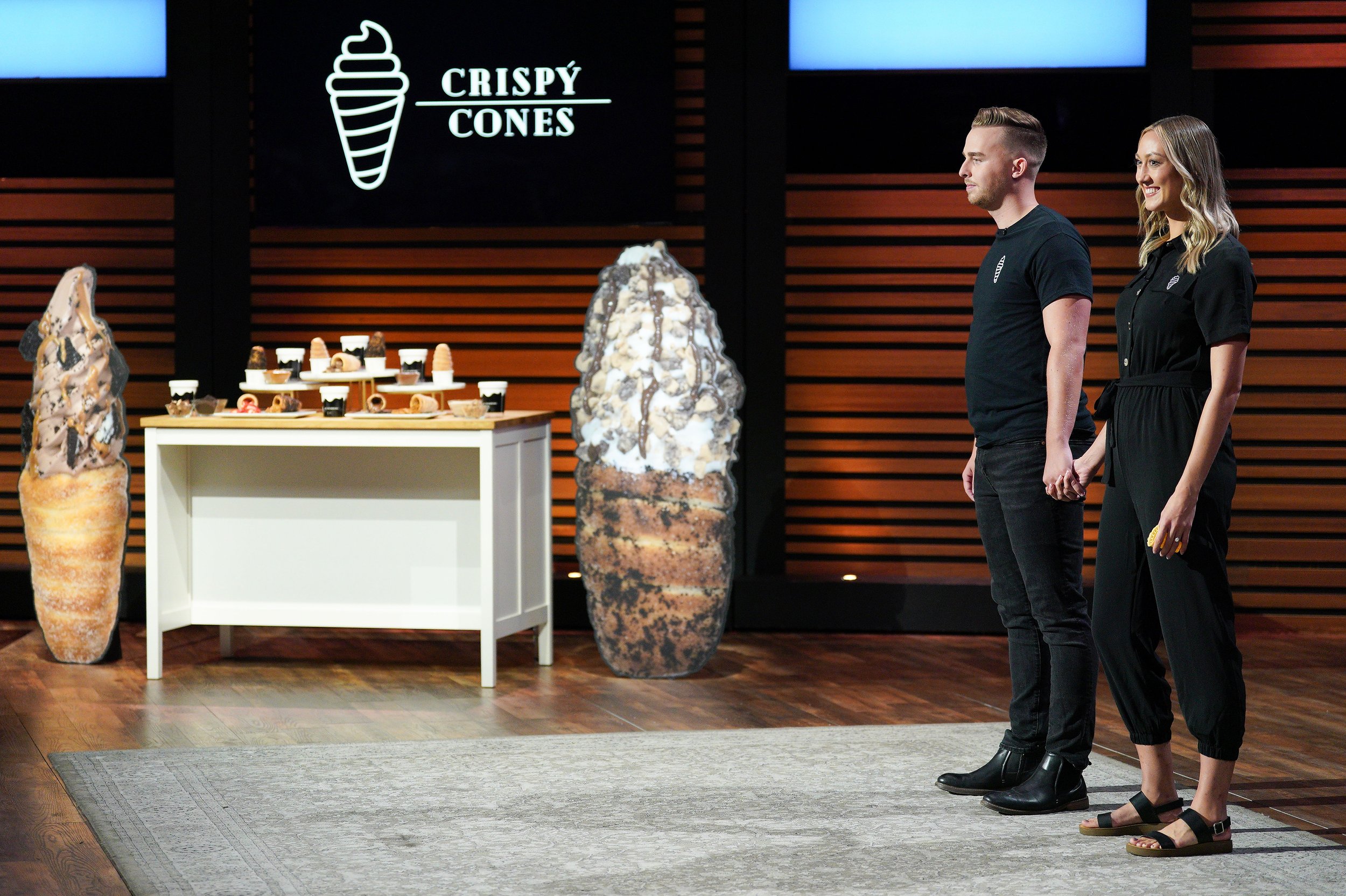
Crispy Cones is much further into the location game. Jeremy and Kaitlyn Carlson brought their rotisserie-grilled dough cones to Season 14, Episode 17, which aired March 17, 2023. They asked for $200,000 for 10%; Barbara Corcoran ultimately invested $200,000 for 20%, betting that the visually distinctive dessert could become a franchise.
That bet has spread quickly. On July 24, 2026, Axios reported that a new Crispy Cones shop in Richmond's Carytown neighborhood was one of roughly 50 outposts nationwide. The cones are based on the Czech pastry traditionally known as trdelník: dough is wrapped around a cylinder, cooked on a rotisserie, coated with cinnamon sugar, and filled with soft serve, spreads, and toppings.
The scale-up looks especially sharp beside reporting from one year earlier. In July 2025, Richmond BizSense described Crispy Cones as having 25 open or soon-to-open locations across 14 states. That is not a perfectly comparable count—one source included planned shops and the other used the broad word “outposts”—so it would be too strong to claim that the open-store count exactly doubled. It does show that the publicly reported footprint has changed dramatically in about a year.
Crispy Cones was already opening in several directions this spring, including Pocatello, Vancouver, Billings, and Charlotte. We covered those openings and the realities of dessert franchising in our Crispy Cones and Cinnaholic franchise update. The Richmond opening adds a cleaner national milestone: approximately 50 locations, according to Axios.
Fifty Stores Are Not the Same as One Successful Store
Franchising transfers much of the cost and local execution to individual operators, which can accelerate expansion. It also creates a different risk. Every location has to produce the dough correctly, manage long wait times, control food costs, and deliver an experience recognizable as Crispy Cones. The company is no longer proving that people will line up for a novel dessert. It is proving that dozens of independent operators can reproduce the product and economics.
Blueland Launches PowerDuo With a $500 Million Goal in Sight
Blueland supplies the biggest number in this update, but it needs precise wording. Forbes reported on August 11 that the company expects to surpass $500 million in lifetime sales by the end of 2026. That is a company forecast for cumulative sales—not a current annual-revenue figure and not a milestone already completed.
The trajectory is still substantial. TIME reported in April that Blueland had recorded $300 million in lifetime sales and grew revenue 80% in 2025. Forbes subsequently reported continued double-digit year-over-year growth, profitability since 2023, and distribution through major retailers including Costco, Target, and Whole Foods. Because Blueland is privately held, neither article supplies a current annual-revenue total suitable for treating as a confirmed run rate.
The Shark Tank origin dates back to Season 11, Episode 1, aired September 29, 2019. Sarah Paiji Yoo and Syed Naqvi asked for $270,000 for 2%, valuing Blueland at $13.5 million. Kevin O'Leary invested $270,000 for 3%. The company later raised approximately $35 million in venture funding by 2021, according to Forbes, but Yoo said profitability became the objective after that financing so the business would not be forced to keep raising capital.
Why PowerDuo Matters More Than Another Scent
PowerDuo Laundry launched August 11 as Blueland's first major category innovation in four years and its biggest product innovation since body wash in 2022. It is a dual-layer laundry tablet: a blue bioenzyme layer is designed to break down stains, while a white oxi-action layer targets odors. According to CEO Sarah Paiji Yoo, the tablet provides 50% more cleaning power and five times more bioenzymes than Blueland's original laundry tablet. Those performance comparisons are company claims reported by Forbes, not independent test results.
The product also preserves the feature that differentiates Blueland from conventional laundry pods: it does not use a plastic film around the detergent. Forbes reports that the formulation uses plant- and mineral-based ingredients and was developed through Blueland's in-house laboratory. The company says it owns more than 60 patents, another indication that its growth strategy depends on product development rather than packaging alone.
PowerDuo arrives while Blueland is changing how it reaches customers. The company spent years primarily selling directly to consumers, where it could explain refill systems in detail and gather feedback. In less than three years, Forbes says it has transformed into a substantial retail operation. That transition matters because a product on a store shelf has seconds—not an entire website—to explain what it is, why it works, and why a shopper should switch.
Three Numbers, Three Completely Different Growth Problems
| Company | Scaling engine | The next test |
|---|---|---|
| R1SE | Company-operated education centers | Can the Frankenmuth model work outside the founders' original communities? |
| Crispy Cones | Franchise operators | Can roughly 50 shops deliver consistent food, service, and unit economics? |
| Blueland | Product innovation plus national retail | Can PowerDuo convert conventional detergent buyers while sustaining profitable growth? |
The milestones are not directly comparable, and that is the point. Three locations can be a major achievement when every facility requires trusted staff and relationships with families. Fifty franchise shops can appear quickly, but consistency becomes harder with every operator added. Nearly $500 million in cumulative product sales reflects enormous consumer reach, yet a company at that scale still has to convince shoppers that its next product works better than the last one.
For R1SE, the next meaningful update will be its first location outside its current Michigan cluster. For Crispy Cones, it will be evidence that the roughly 50-location network is durable, not simply that franchise agreements can be sold. For Blueland, it will be confirmation that lifetime sales crossed the forecast threshold—and whether PowerDuo becomes a repeat-purchase staple. Until then, the clean scoreboard is three operating R1SE centers, roughly 50 reported Crispy Cones outposts, and a $500 million year-end target for Blueland.
Sources
- Michigan After-School Program R1SE Grows From One Location to Three — Mid-Michigan NOW, August 12, 2026
- Freeland's Trevor Szafranski Lands Shark Tank Deal for R1SE — Midland Daily News, March 25–26, 2026
- R1SE Founders Say Shark Tank Appearance Opens Doors Across the Country — Midland Daily News, March 29, 2026
- Carytown Gets a Czech-Inspired Twist on Ice Cream Cones — Axios Richmond, July 24, 2026
- Ice Cream Shop Crispy Cones to Open in Former Carytown Burgers & Fries — Richmond BizSense, July 28, 2025
- Blueland Bets on Its Biggest Innovation Yet as It Nears $500 Million in Lifetime Sales — Forbes, August 11, 2026
- Blueland: TIME100 Most Influential Companies 2026 — TIME, April 30, 2026
- Shark Tank Season 11 Episode 1, Season 14 Episode 17, and Season 17 Episode 15 — pitch and deal facts cross-checked against the site's Shark Tank dataset.